Get in touch
Learn more about how to drive better business outcomes with financial benefits that make a difference.
Thank you! Your submission has been received!
Oops! Something went wrong while submitting the form.


Security contracts aren’t usually lost because of pricing; they’re lost because of reliability.
In most industries, internal staffing issues can be hidden from the customer. In security, the customer experiences them directly. When a post is uncovered or covered late, it becomes a real-time service failure. And once service reliability becomes a question, everything you do gets evaluated through that lens.
That’s why staffing volatility is not just an HR problem in security. It’s a contract risk.
Most clients won’t tell you “your turnover is too high.” What they’ll say is something like:
Those statements are all symptoms of the same root issue: the operation is struggling to maintain predictable coverage. And clients don’t measure you by intent. They measure you by outcomes.
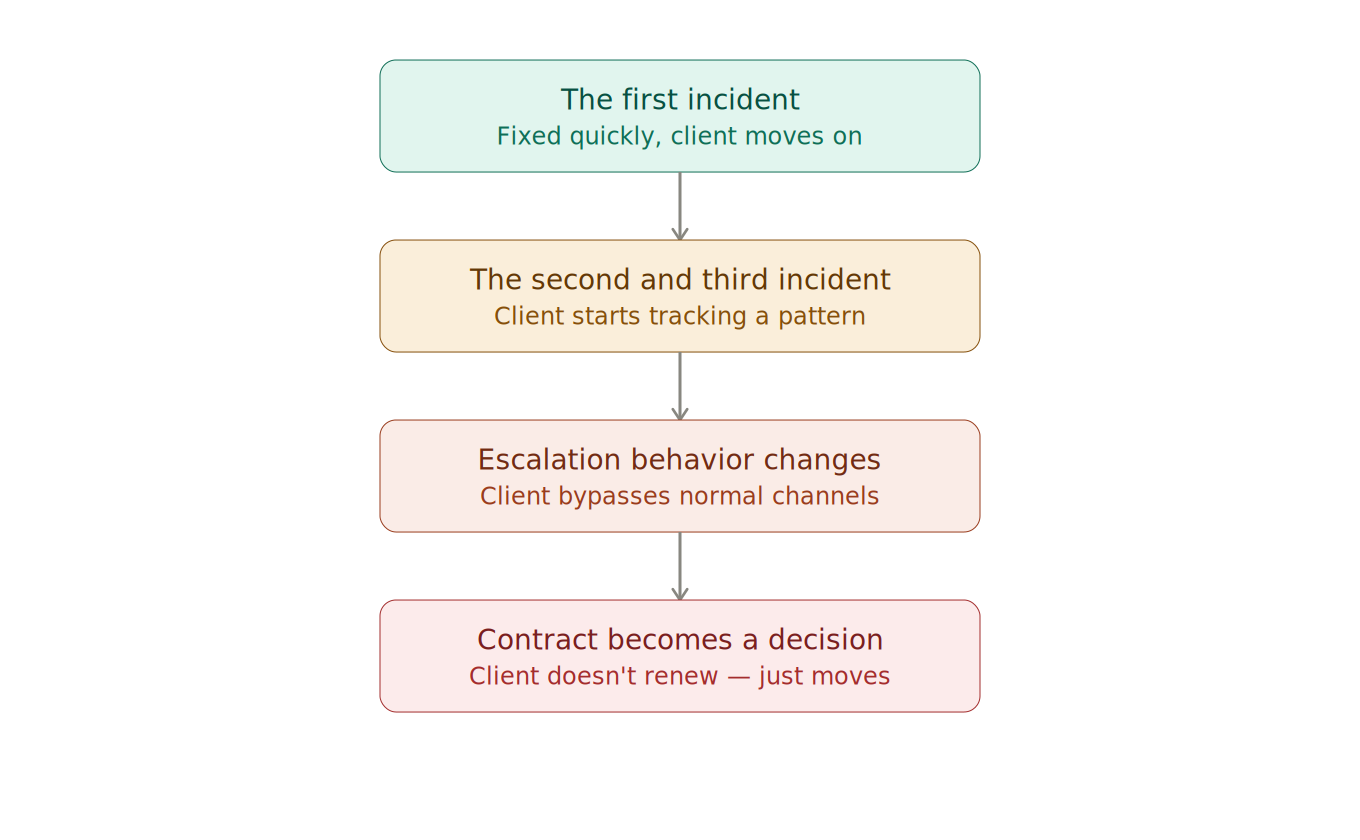
This is how contracts quietly move from “stable” to “at risk,” even if the relationship still feels friendly:
Step 1: The first incident
One uncovered post, one late arrival, one missed check-in. You fix it quickly. The client moves on.
Step 2: The second and third incident
Now it feels like a pattern. The client starts tracking. They may not say it, but they're watching.
Step 3: Escalation behavior changes
The client begins bypassing your normal channels. They contact leadership. They demand reporting. They ask for "a plan."
Step 4: The contract becomes a decision
At renewal time, pricing becomes a lever - but reliability is the reason. In many cases, the client doesn't even negotiate. They just move.
The dangerous part is that this can happen while your team feels like you’re “handling it.” Because internally you are. But the client is feeling the instability.
Why security is uniquely vulnerable to the churn-to-coverage loop
Security has a structural problem that makes volatility expensive:
So when turnover rises, coverage breaks. When coverage breaks, overtime rises. When overtime rises, your best people burn out. And burnout creates more turnover.
That loop is the real contract risk.
Most operators assume reliability comes down to supervision, discipline, or recruiting. Those matter but they’re not the whole story.
A huge driver of call-outs and job-hopping is paycheck timing stress. When someone is living paycheck to paycheck, a small financial shock can force a bad choice:
This is why the Cobraste solution that reduces pay timing stress can have an outsized impact on reliability in security operations.
Cobraste Earned Wage Access (EWA) gives officers access to wages they’ve already earned, when they need it.
In security, that translates to improved post coverage because it reduces the cash timing pressure that triggers missed shifts and job-hopping. It’s not a replacement for supervision. It’s a stability lever that makes your workforce more consistent.
It’s also proven in the security industry. In a major security employer case study, on-demand pay was directly tied to improved attendance because employees knew that working one day would result in money available quickly.
Cobraste is production-ready in Puerto Rico and already integrated with the leading payroll/workforce providers.
When reliability improves, the entire contract relationship improves. You see it in:
Because reliability is the product. Everything else is secondary.
Most security leaders don’t need more information on why reliability matters - they need a low-effort path to execution.
Cobraste EWA is designed to break the coverage volatility cycle fast. And we’ve packaged the rollout end-to-end (training, employee onboarding, and communications) so you can implement without draining your team’s time. When you’re ready to move, the path is straightforward and it moves quickly.

