Get in touch
Learn more about how to drive better business outcomes with financial benefits that make a difference.
Thank you! Your submission has been received!
Oops! Something went wrong while submitting the form.

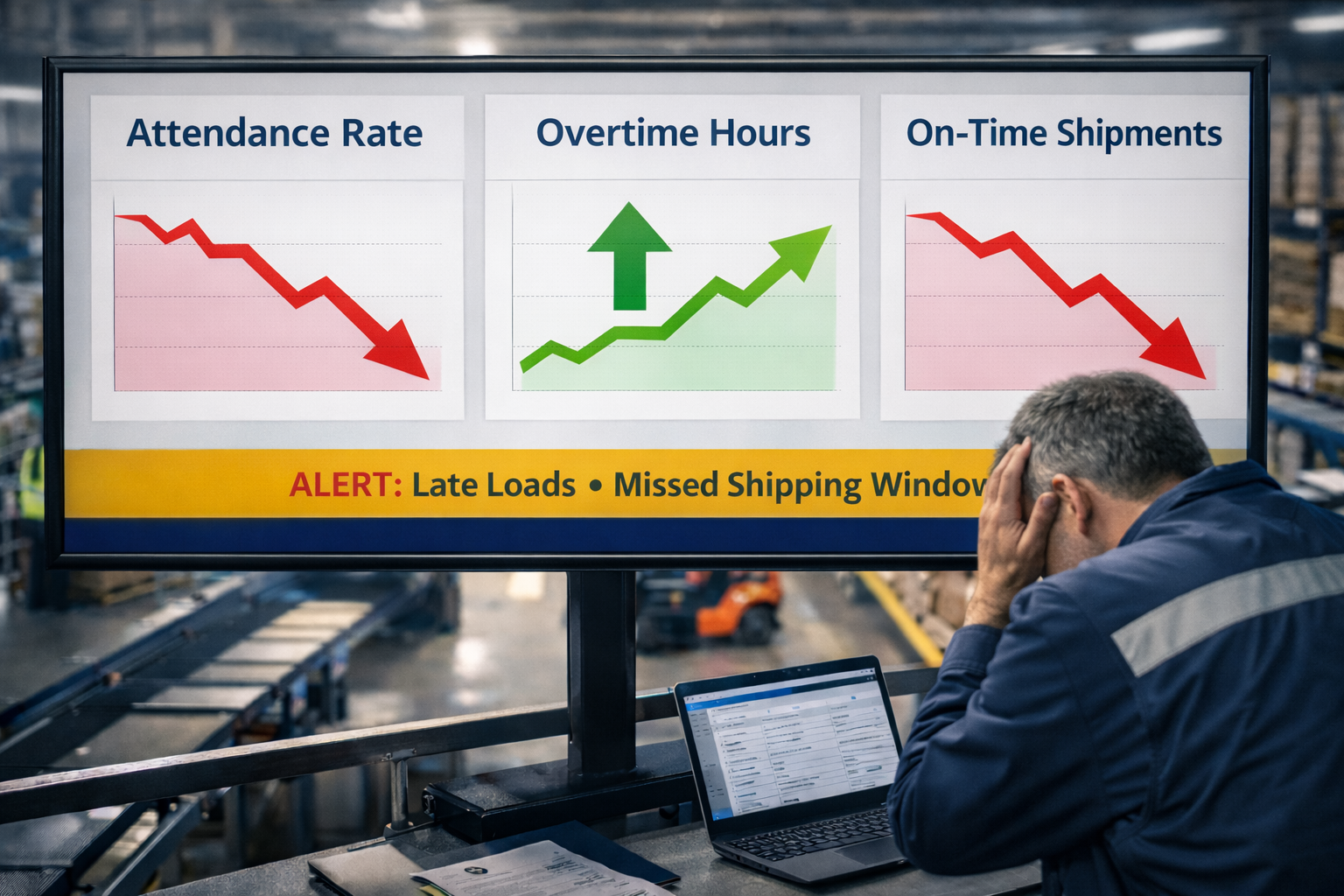
If you run a distribution center, you already know the drill. A shift starts, and a handful of people don't show up. A promising associate quits after six weeks. You pour time and money into onboarding someone new, and then, three weeks later, the cycle repeats.
Most operators chalk this up to “the nature of the industry.” Turnover at distribution centers and fulfillment warehouses is notoriously high: often in the 40-60%+ range in hourly roles depending on the specific job type. When pressed, managers point to physically demanding work, repetitive tasks, and competition from nearby employers offering similar wages.
But here's what those explanations miss: a large and growing body of evidence points to financial stress, not the job itself, as one of the primary drivers of turnover and absenteeism in hourly workforces. And the fix is giving workers access to what they've already earned, when they actually need it.
That's exactly what Cobraste's Earned Wage Access (EWA) platform does and the impact on distribution centers is transformative.
Let's start with the numbers, because they're staggering once you see them laid out clearly.
The average cost of replacing an hourly warehouse or distribution center worker ranges between $3,000 and $5,000 per employee when you factor in recruiting costs, background checks, onboarding time, training hours, lost productivity during the ramp-up period, and management time diverted to cover gaps.
The math is startling: if your DC employs 200 people and turns over at a conservative 40 percent annual rate, that's 80 replacements per year. At $4,000 per replacement, you're absorbing $320,000 in turnover costs annually! Costs that don't show up as a single line item on any report, but quietly erode your margins, your team morale, and your operational reliability every single day.
And that doesn't even account for absenteeism: the no-call, no-shows and last-minute callouts that throw off your shift planning, force overtime on your reliable team members, and reduce throughput on your busiest days.
For most distribution center operators, this is simply believed to be the cost of doing business but it certainly doesn't have to be.
Here's a question worth reflecting on: why do employees leave jobs that pay a fair wage, offer consistent hours, and provide a manageable commute?
The answer, more often than employers realize, is financial survival. Many studies have found that a majority of workers would struggle to cover an unexpected $400 expense from savings alone. For most warehouse and distribution center workers, a medical bill, a car repair, or even a gap in a family member’s work schedule can create a financial crisis that a paycheck arriving in 5 to 10 days simply cannot solve.
When workers are financially stressed, their behavior changes in ways that look like disengagement or unreliability but are actually symptoms of a deeper problem:
• They miss shifts because they can't afford gas, a rideshare, or transit to get to work before they're paid.
• They take on a second job and that second job starts to take priority.
• They borrow from payday lenders at predatory rates compounding their stress.
• They mentally check out increasing error rates and lowering performance.
In other words, the two-week or weekly pay cycle is quietly working against your retention strategy. You're asking people to deliver daily but not be able to access any of their earnings for one or two weeks. For new workers you are asking them to work for up to three weeks before they receive any of their earnings. That timing mismatch is the problem.
Cobraste Earned Wage Access, sometimes called EWA, allows employees to access a portion of their already earned wages before their scheduled payday. There are no loans involved. No interest. Workers are simply accessing money they've already worked for, on a timeline that matches their real financial needs.
Cobraste’s EWA platform is designed to be low-lift for your team. It works with standard, easily exportable payroll and timekeeping reports, so you can launch without a complex payroll integration and typically without needing IT involved. Employees access earned wages through a simple mobile app, and funds are delivered quickly so they can handle real-life expenses and stay focused at work.
Operations that implement Cobraste consistently see improvements across four critical metrics:
• Attendance and punctuality improve because workers can afford to show up.
• Turnover rates decline as employees feel financially supported and less desperate to job-hop.
• Time clock compliance strengthens; in some implementations, Cobraste clients have reported 80%+ improvement in punch compliance after implementing EWA.
• Morale and engagement rise when employees feel their employer actually cares about their financial wellbeing.
Let's make this tangible. Below is a simplified illustration for a distribution center with 200 hourly employees:
Distribution centers are uniquely positioned to see dramatic results from Cobraste’s EWA program; here's why.
First, the workforce is predominantly hourly. Every hour worked is tracked, earned, and calculable which makes the Cobraste EWA model straightforward to implement and easy for employees to understand.
Second, the financial profile of warehouse workers puts them squarely in the segment most impacted by paycheck gaps. These are hardworking people with real financial obligations who don't have savings buffers to absorb the gaps in the standard pay cycle.
Third, distribution centers operate on thin margins where operational continuity is everything. A single missed shift can cascade: slower throughput, overtime costs, missed shipping windows, and customer dissatisfaction. Every percentage point of improvement in attendance has a direct and measurable impact on your bottom line.
And fourth, the competition for hourly workers is fierce. Distribution centers compete for the same labor pool with retail, restaurants, logistics, construction, and even gig platforms like Uber and Doordash. Cobraste has become a genuine differentiator in recruiting as candidates increasingly ask about it, and employers who offer it win more acceptances.
One of the most common concerns distribution center leaders raise is implementation complexity. The assumption is that changing anything about payroll is slow, painful, and expensive.
Cobraste is built to eliminate that friction. Because it works from standard payroll and timekeeping reports, you can go live quickly without overhauling existing processes or creating ongoing admin work for your payroll team. Cobraste also handles employee education and onboarding, so your HR team never feels burdened with Cobraste.
From the employee's perspective, it's even simpler: download the app, connect to your employer, and you can access your earned wages when you need them. No paperwork. No waiting.
The distribution centers winning the talent war right now are the ones that have figured out how to support their workers between paychecks and removing the financial friction that drives people out the door.
Cobraste's Earned Wage Access is not a perk. It's an operational strategy. It reduces costs, improves reliability, and quickly builds workforce loyalty.
If your distribution center is struggling with attendance, turnover, or both - the solution is probably simpler than you think.
Connect with a solutions expert to learn what Cobraste could mean for your DC.

